How to Get Paid Internationally: The 2026 Guide for Global Workers
-
 Avvio Team
 - 12 Jun, 2026
Quick answer: To get paid internationally, you receive money into an account that can hold foreign currency. The three common routes are a bank wire, a transfer service like Wise or Payoneer, or a global account that gives you local USD or EUR account details. For most freelancers and remote workers, the cheapest and fastest option is a dedicated USD or EUR virtual account. Clients pay you like a local, and you hold the funds instead of converting the moment they land.
Getting paid is supposed to be the easy part. Then your client is in one country and you’re in another, and a simple payment turns into wire fees, a bad exchange rate, a few days of waiting, and the occasional frozen transfer. This guide breaks down every realistic way to get paid across borders in 2026, what each one actually costs, and how to pick the right one for how you work.
Key takeaways
The global average cost of sending money across borders is 6.36%, according to the World Bank (Q3 2025). That’s more than double the UN’s 3% target. Banks are the most expensive channel, averaging roughly 15% per transfer, while digital methods are far cheaper. An estimated 40 million people now work as digital nomads worldwide (MBO Partners / World Economic Forum, 2025), and getting paid across borders has gone mainstream. For most freelancers and remote workers, a USD or EUR virtual account is the best fit: clients pay local bank details, and you hold the currency instead of losing money on a forced conversion.
Why getting paid across borders is so hard
Cross-border payments are expensive and slow because your money usually passes through several middlemen. Your client’s bank, one or more correspondent banks, then your bank, each taking a fee and applying its own exchange rate. According to the World Bank, sending money internationally costs an average of 6.36% of the amount sent, and banks stay the priciest route at close to 15%. On a $3,000 invoice, that’s real money gone on every single payment.
This matters more than ever, because cross-border income isn’t niche anymore. Global remittances reached roughly $905 billion in 2024 (World Bank), and an estimated 40 million people work as digital nomads, with tens of millions more freelancing for clients abroad. The old system was built for the occasional transfer, not for people who get paid internationally every month.
Three problems show up again and again. There are hidden FX costs, where a headline “no fee” quietly marks up the exchange rate. There’s speed, since traditional wires can take 1 to 5 business days. And there’s control, because funds can be held for review, and you may be forced to convert to local currency the moment the money lands.
How do you get paid internationally? The 5 main methods
There are five realistic ways to receive money from abroad. Here’s how they stack up.
| Method | Best for | Typical cost | Speed | Holds USD/EUR? |
|---|---|---|---|---|
| Bank wire (SWIFT) | Large one-off payments | High (fees + FX, ~3% to 15%) | 1 to 5 days | Sometimes |
| PayPal | Quick small payments | High (FX + fees) | Minutes to hours | Limited |
| Transfer services (Wise, Payoneer) | Freelancers, regular invoices | Low to medium | Same day to 2 days | Yes (some) |
| USD/EUR virtual account | Recurring global income | Lowest. Hold and convert on your terms | Often same day | Yes |
| Stablecoin / crypto rails | Crypto-native earners | Low | Minutes | Yes (digital dollars) |
For most people earning regularly from abroad, a USD or EUR virtual account wins, because it removes the forced-conversion problem. You receive in the currency you were paid, hold it, and decide when, or whether, to convert.
What is a USD or EUR virtual account?
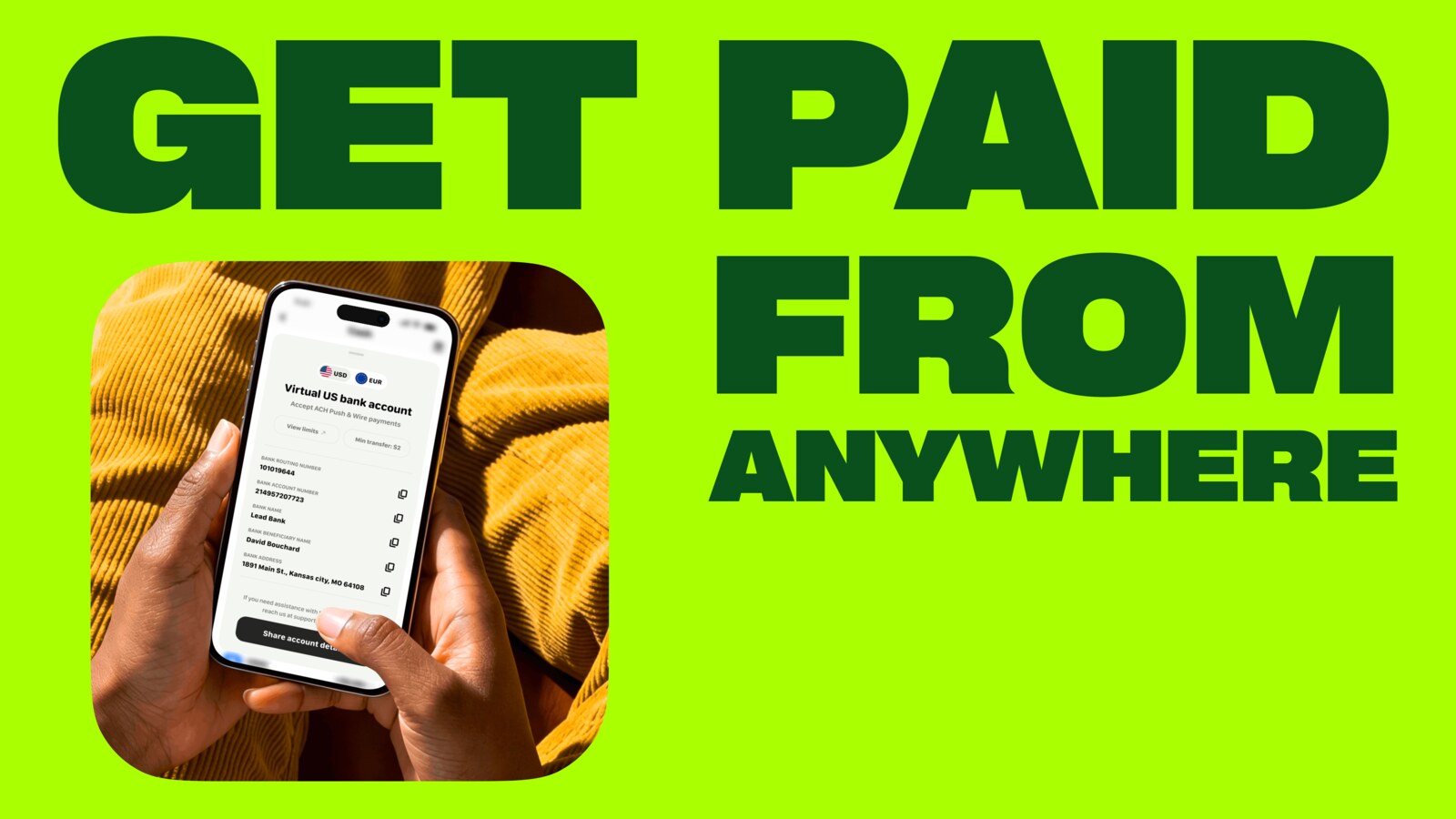
A USD or EUR virtual account is a set of dedicated bank account details, an account number and routing number, or an IBAN, that lets you receive payments in that currency as if you had a local bank account in the US or Europe. Your client sends a normal local transfer, and you receive and hold the funds without a traditional bank in that country. (For the full explainer, see what a virtual bank account is.)
This is the mechanism behind modern global money apps. Instead of routing through expensive correspondent banks, you get local rails on both sides. The practical wins: clients pay easily, you skip forced conversions, and you keep the money in a stable currency until you need it.
One distinction worth understanding. Some providers are custodial, meaning a company holds your funds. Others are self-custody, meaning you hold the keys to your own balance. Self-custody puts fewer parties between you and your money, which is worth weighing if control matters to you.
What’s the cheapest way to get paid from overseas?
The cheapest way to get paid from overseas is a digital method that lets you receive and hold the original currency rather than converting on arrival. The World Bank found digital channels average 4.59%, versus nearly 15% for banks, and dedicated USD or EUR accounts can cut that further by letting you skip unnecessary conversions. The real cost of any method is the fee plus the exchange-rate spread, so always check both.
How to choose the right way to get paid
Pick your method based on four things, in this order. First, how often you get paid: recurring income rewards a dedicated account, while one-off payments may not. Second, what currency you’re paid in: if clients pay USD or EUR, hold it rather than converting on every payment. Third, total cost, meaning fees and the FX spread together, because “zero fee” can still hide a poor rate. Fourth, control: do you want a company holding your funds, or do you want to hold them yourself?
The best option by situation
If you’re a freelancer with international clients, a USD or EUR virtual account lets you invoice and get paid like a local, then hold or convert on your terms.
If you’re a remote employee paid from another country, you want stable account details your employer can pay into, plus the ability to spend locally without FX fees. See our guide to banking for digital nomads.
If you live between countries, look for one account that receives, holds, and spends in multiple currencies.
If you’re in a country where USD access is hard, for example because of local banking limits or currency controls, a virtual USD account can be the most reliable way to get paid in dollars.
How to set up a global account to get paid: step by step
First, choose a provider that offers dedicated USD or EUR account details and supports your country. Second, complete identity verification (KYC), a normal requirement for any regulated money service. Third, get your account details: an account number and routing number for USD, or an IBAN for EUR. Fourth, share them with clients or your employer the way you’d share any bank details on an invoice. Fifth, receive, hold, and decide when to convert, spend, or earn on the balance.
Frequently asked questions
How do I receive money from another country? You receive money from another country into an account that can hold foreign currency: a bank account, a transfer service, or a USD or EUR virtual account. For regular payments, a virtual account with local USD or EUR details is usually easiest and cheapest, because clients pay a normal local transfer and you hold the funds.
What is the cheapest way to get paid internationally? Digital methods are cheapest. The World Bank reports digital transfers average around 4.59%, versus nearly 15% for banks. A dedicated USD or EUR account can lower the cost further by letting you skip forced currency conversions.
Can I get paid in USD if I don’t live in the US? Yes. A USD virtual account gives you US account details to receive dollars without a US-based bank, even as a non-resident. You hold the USD and convert only when you choose.
How long do international payments take? It depends on the method. Bank wires typically take 1 to 5 business days, while digital transfers and virtual-account payments often arrive the same day.
Is it safe to get paid through a money app instead of a bank? Reputable money apps operate through licensed partners and use strong security, though most are not banks themselves, and balances are typically not government-insured. Check whether the provider is custodial or self-custody, and review its partner and security disclosures.
Do I pay tax on income received from abroad? Usually yes. Income is generally taxable based on where you’re a tax resident, regardless of where it’s paid. Rules vary by country, so confirm with a local tax professional.
Get paid like a local, anywhere
If you earn across borders, the goal is simple. Receive money in a stable currency, keep control of it, and stop losing a slice to fees and bad exchange rates on every payment.
Avvio is built for exactly this. Dedicated USD and EUR account details to get paid across 120+ countries, the ability to hold your currency, earn up to 7% APY on it, and spend on a card with 0% FX fees, all in one self-custody account where you hold the keys.
Avvio is a financial technology company, not a bank. Accounts, cards, custody, and yield are provided by licensed partners and protocols. Balances are not FDIC-insured and availability varies by jurisdiction. This article is for information only, not financial advice.